
Why Your Ducted AC Won't Heat: Sydney Winter Troubleshooting
If your ducted aircon won't heat Sydney homes properly in winter, don’t panic. In most cases, the fix is simple: wrong settings, a dirty air filter, blocked return air, or zoning. This 2026 guide walks you through safe checks first—then the technician-level causes.
This guide is written from the perspective of a Sydney ducted air conditioning team that troubleshoots “ducted heating not working” calls through real winter conditions—especially cold mornings, damp nights, and homes with zoning. (EEAT reference: ACG’s 2026 ducted problems resource.)
Service area: Sydney • Location: 182A Canterbury Rd, Canterbury NSW 2193 • Phone: 0280213735
1) Introduction & First Impressions
Before you start: 3 safety rules (simple, but important)
-
If you smell burning, see sparks, or the breaker keeps tripping—stop. That can point to an electrical fault (tripping circuit breaker ducted aircon). Call ACG Sydney.
-
Don’t open sealed panels or touch wiring. Anything beyond filters/vents/controls is technician territory.
-
Give heating time. Reverse cycle heating can take 5–15 minutes to feel “properly warm” through vents—especially on cold starts.
2) Product Overview & Specifications
What’s “in the box” (typical ducted setup)
Key specifications that matter (for heating performance)
| Spec | Why it matters in Sydney winter |
|---|---|
| Airflow (how much air moves) | Low airflow = weak heat, slow warm-up, or rooms not heating evenly. |
| Zoning (which rooms get air) | If a zone control is not working, some rooms can feel cold while others are fine. |
| Defrost behavior | Outdoor unit can ice up; defrost cycle can pause heating briefly. |
| Controls (setpoint, fan speed, schedule) | Wrong setpoint, AUTO mode, or timer can make it look “broken” when it isn’t. |
Visual: How the system moves heat (simple diagram)

This is a general AC diagram to explain terms like compressor, coils, and expansion valve—so the rest of this guide stays easy to follow.
3) Design & Build Quality
What “good” looks like (for heating)
-
Return air grille is clear No furniture pressed against it. No dust blanket on the filter.
-
Supply vents are open Closed vents can create insufficient airflow heating mode and cause short cycling.
-
Ductwork is intact Duct leaks / crushed flexible ducting can dump warm air into roof space.
Durability observations (Sydney reality)
Sydney winters aren’t “snowy cold,” but damp + cold mornings can trigger outdoor icing. The outdoor unit icing up is common in tight, poorly ventilated spots. Indoors, the most common long-term issue is dust (dirty air filter ducted system) reducing airflow.
Visual: HVAC airflow + components
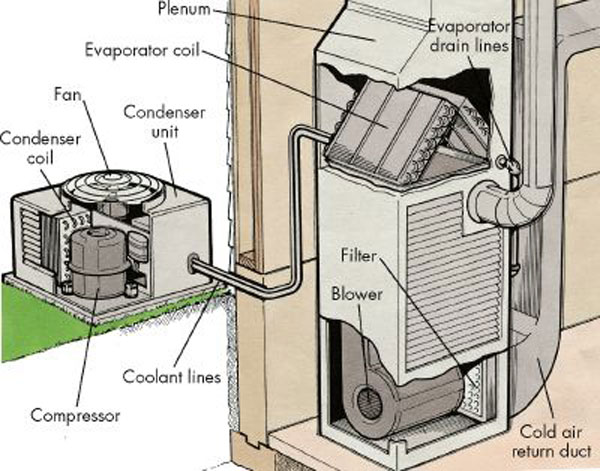
Use this to locate the return air, filter, and indoor unit—your starting points for “ducted heating not working.”
4) Performance Analysis
4.1 Core Functionality (Primary use cases)
Quantitative measurements (simple “home tests” you can do)
Vent Temperature Rise Check (DIY)
This is a “directional” test (not lab-grade). It helps you decide if the system is heating at all.
Tip: Do this with fan speed on AUTO (or medium) and all main vents open.
Real-world Sydney winter scenarios (quick reads)
Scenario A: “It’s cold in the morning, then it’s fine later.”
Often normal behavior + house heat loss. If you also hear the outdoor unit change sound and airflow, that can be ducted aircon frost mode / defrost cycle. If it’s every few minutes, that’s not normal—keep reading.
Scenario B: “Some rooms heat, others don’t.”
Classic zoning: a zoning damper stuck closed, a zone not enabled on the controller, or a duct issue. This is the “ducted AC heating works in some rooms only” pattern.
Scenario C: “It runs, but never reaches the set temperature.”
Could be undersized system, poor insulation, or airflow restriction. Also possible: sensor (thermistor) reading wrong, or a refrigerant/valve issue.
4.2 Key Performance Categories (Sydney winter-focused)
Category 1: Airflow (the #1 reason heating feels weak)
- Dirty air filter ducted system → clean/replace.
- Blocked return air grille → clear it.
- Supply vents closed / registers closed → open them.
- Duct leaks / crushed flexible ducting → likely needs a technician to inspect in roof space.
- Air balancing for ducted heating → helps with “some rooms cold” problems.
Category 2: Controls & settings (HEAT vs AUTO, setpoint, schedule)
- Air conditioner heat mode not working often equals “not actually on HEAT.” Set mode to HEAT.
- Incorrect temperature setpoint: set it to 24–26°C for testing.
- Schedule/timer turned on accidentally: disable schedules for the test.
- Controller battery low / controller reset: replace batteries (if applicable) and reboot controller.
- Fan speed for heating (low vs auto): use AUTO/medium during testing.
Category 3: Outdoor unit + defrost cycle (often misunderstood)
- Outdoor unit icing up in a tight alcove or behind clutter.
- Defrost cycle taking too long or happening repeatedly.
- Compressor not ramping up (system runs but feels weak).

Interactive: Sydney Winter “No Heat” Troubleshooting Wizard (2026)
Answer these questions and you’ll get a likely cause + next steps. This is designed for the most common “ducted air conditioning problems Sydney” homeowners report.
5) User Experience
Setup / installation process (why it matters for heating)
Ducted heating performance is heavily affected by the original setup: duct sizing, zoning layout, return air location, and airflow balancing. If you’re planning changes (renovations, room conversions), it’s worth reviewing design before you blame the “unit.”
Helpful internal resources:
• DIY guide to ducted air conditioning in Sydney (planning + basics)
• Air conditioning installation (Sydney) — when design is the real fix
Daily usage (simple “best settings” for Sydney winter)
-
Use HEAT mode (not AUTO) when troubleshooting “HEAT” mode vs “AUTO” mode ducted can change behavior, especially on cold starts.
-
Set test temperature to 24–26°C for 15 minutes If it still won’t warm, you likely have an airflow or technical fault.
-
Keep key vents open Closing too many vents can cause insufficient airflow heating mode and short cycling.
-
Clean filters at the start of winter Preventative maintenance reverse cycle = fewer “won’t heat” surprises.
Learning curve: the 3 controller mistakes we see most in Sydney
- Mode confusion: It’s on “AUTO” or “FAN” not HEAT (aircon thermostat not working is often just settings).
- Timer surprises: A schedule/timer turned on accidentally stops heating mid-evening.
- Zoning mismatch: The zone you’re sitting in is OFF, or dampers are stuck—so it “heats the wrong rooms.”
6) Comparative Analysis
| Option | Best when… | What you do |
|---|---|---|
| DIY troubleshooting | It’s the first cold week and heating feels weak / not warm. | Settings, setpoint, fan speed, filters, return grille, vents, basic zoning checks. |
| Ducted air conditioning service Sydney | It “sort of works” but takes too long, smells dusty, or heat is uneven. | Clean and inspect system, confirm airflow, check sensors, verify defrost behavior. |
| Ducted heating repair Sydney | You get persistent cold air on HEAT, repeated short cycling, or power issues. | Technician diagnosis: thermistor / temperature sensor fault, PCB fault, reversing valve fault, refrigerant leak symptoms heating. |
| Upgrade to high efficiency ducted | Your system is older, noisy, expensive to run, or needs frequent repairs. | Review sizing, duct layout, zoning design; replace ducted air conditioner Sydney. |
7) Pros and Cons
What We Loved
- Whole-home comfort when airflow and zoning are right.
- Fast wins: many “no heat” calls are solved with settings + filter + return air.
- Quiet, even heat compared to portable heaters when tuned correctly.
Areas for Improvement
- Zoning complexity: a single stuck damper can “break” one side of the house.
- Hidden duct issues: crushed flexible ducting or duct leaks can be hard to spot without inspection.
- Defrost confusion: normal winter defrost can feel like a fault if you don’t know what to expect.
8) Evolution & Updates (2026 notes)
What changes the “no heat” experience most?
- Better sensor accuracy → fewer wrong temperature readings (thermistor issues).
- Improved defrost logic → fewer long pauses during cold snaps.
- Better zoning design → fewer “some rooms heat only” complaints.
9) Purchase Recommendations (aka: what to do next)
Best For
- Homes that want whole-house heating with zoning flexibility.
- Families who want one system to handle cooling + heating.
- People who’ll do annual service before winter (or schedule it).
Skip If
- You only need one small room heated occasionally (a simpler option may suit).
- You can’t keep returns/filters clean (performance will suffer fast).
- Your home has major insulation/air-leak issues and you’re not ready to address them.
If you’re stuck: “Call or keep troubleshooting?”
- Breaker trips (tripping circuit breaker ducted aircon) or power issues (voltage drop / 3-phase imbalance where applicable).
- Persistent cold air on HEAT after 15 minutes with clean airflow.
- Outdoor unit icing is heavy and frequent, or defrost takes too long.
- Signs of technical faults: reversing valve, PCB / control board fault, sensor faults, refrigerant leak symptoms heating.
10) Where to Buy
Trusted option (Sydney)
ACG Air Conditioning Sydney — 182A Canterbury Rd, Canterbury NSW 2193, Australia • Phone: 0280213735 • Website: airconditioningguys.com.au
Watch-outs: vague sizing, vague duct layout, and “set-and-forget” zoning setups that don’t match how you actually use the home.
11) Final Verdict
Bottom line: If your ducted system won’t heat in Sydney winter, start with settings and airflow. If the wizard points to a technical issue—or you see power trips, persistent cold air, or repeated defrost problems— it’s time for a proper diagnosis by ACG Sydney.
12) Evidence & Proof
Photos / diagrams (embedded)
These visuals explain what we mean by “heat pump cycle,” “airflow,” and “components.”